The pioneering system of global wildlife tracking resumes after three-year pause
- Back in orbit: ICARUS will be installed on the GENA-OT satellite, launched on 19 November by German launch integrator Exolaunch as part of SpaceX’s Transporter-15 mission aboard Falcon 9.
- Flying on a CubeSat: The ICARUS receiver, developed by the company TALOS, is aboard the Gena-OT research satellite belonging to the University of the Bundeswehr Munich and built by the Munich-based company OroraTech.
- Mission starts after test phase: After a three-month testing phase in orbit, ICARUS will resume satellite-based tracking of animals worldwide.
After a three-year pause, ICARUS, the pioneering project that tracks wildlife from space, is set to resume operations. On 19 November 2025, a rocket will carry a satellite equipped with the ICARUS receiver into space—opening a new chapter in the study of animal observation.
During the first three months in orbit, the system will undergo extensive testing. Once operational, ICARUS will establish a continuous link with miniature sensors on animals across the globe, enabling scientists to monitor the locations, behavior, health, and environmental conditions of species ranging from migratory birds and bats to sea turtles and large mammals. For the first time, ICARUS will offer full global coverage—a critical leap forward in understanding biodiversity, ecosystem health, and the impact of climate change.
For ICARUS, the 19 November launch is only the beginning: a second receiver will follow in 2026, carried by an independent satellite from the Max Planck Society and the space company TALOS. Additional satellites are already in the planning stage. Together, they will form ICARUS 2.0, a constellation designed to deliver more frequent and higher-resolution data faster than ever before.
“With ICARUS 2.0, we are building a truly planetary-scale observatory,” said Martin Wikelski, Director at the Max Planck Institute of Animal Behavior. “For the first time, we will be able to listen to the signals of animals worldwide in near real time, offering unique insights on biodiversity and environmental change.”
From ISS to CubeSat
ICARUS first took flight in 2020 as a technological experiment aboard the International Space Station (ISS). An antenna on the ISS collected signals from lightweight sensors attached to animals, providing unprecedented insights into migration routes, breeding behaviors, and survival strategies. The project quickly proved its value: in its first year, ICARUS delivered datasets on dozens of species worldwide. However, the war on Ukraine in 2022 brought the ICARUS collaboration with Russia to an abrupt end. ICARUS paused operations. For the team behind the project, this pause became an opportunity to reimagine the technology from the ground up.
Working with the Munich-based NewSpace company TALOS, engineers miniaturized the ICARUS system into a ten-centimeter payload that can fly on a tiny satellite known as a CubeSat. Compared to the ISS-based prototype, the new receiver consumes one tenth the energy, reads four times as many sensors, and enables faster data downloads and remote software updates. It was successfully tested in an experimental orbital flight in 2023.
“What once required a massive antenna on the International Space Station now fits into the palm of a hand,” says Gregor Langer, CEO of TALOS.
First receiver in orbit
The space mission was made possible by a collaboration between ICARUS and the SeRANIS research mission of the University of the Bundeswehr Munich (UniBW). SeRANIS is funded by the European Union – NextGenerationEU at the Bundeswehr Centre for Digitalisation and Technology Research. With a budget of approximately €70 million and a fleet of small satellites serving as a “laboratory in orbit”, SeRANIS is one of Germany’s largest university space programs. The new ICARUS receiver is flying on the Gena-OT CubeSat. The satellite is a platform developed by the Munich-based company OroraTech. The mission was funded by the German Aerospace Centre (DLR).
“We are delighted to have ICARUS in our orbital laboratory,” says Andreas Knopp, spokesperson for the SPACE Research Centre at the University of the Bundeswehr and head of the SeRANIS program. “We have been happy to provide technological support for Martin Wikelski’s groundbreaking work from the very beginning, and have learned a great deal ourselves in our scientific cooperation. We are convinced that Germany should derive much more benefit from projects of this kind.”
After a three-month test phase at an altitude of around 500 kilometers, ICARUS will begin two-way communication: miniature sensors attached to animals will begin transmitting high-precision GPS data to the satellite, which will in turn relay it back to researchers on Earth. This bi-directional function also means that scientists can remotely reprogram sensors without having to remove them from animals.
ICARUS 2.0: a new chapter in wildlife tracking
The second receiver has already been built and is scheduled to launch into space aboard a SpaceX mission in 2026. Independently operated by TALOS and the Max Planck Society, and funded by the National Geographic Society, this satellite will double the frequency of ICARUS data collection.
By mid 2027, a constellation of six ICARUS receivers is expected to be operational, creating an array that guarantees continuous functionality and delivers near real-time information on animal movements. This improved coverage will allow scientists to monitor animals’ well-being with unprecedented accuracy, detect disease outbreaks at their earliest stages, and anticipate ecological shifts that affect both wildlife and humans.
“This capability radically increases the speed with which we can respond to global challenges such as habitat loss, disease outbreaks, and shifting migration patterns,” says Wikelski, who is also a professor at the University of Konstanz.
Complementing the new receivers are a suite of next-generation animal tags currently under development. According to Gregor Langer from TALOS, which is the company developing the tags, “ICARUS tags will be among the lightest, smallest, and most energy-efficient sensors on the market.” These tiny, ultra-light sensors will not only record location data but also temperature, humidity, air pressure, and acceleration. Thanks to sophisticated on-board data pre-processing, they will give researchers a holistic view of animal health and behavior within their environments.
A global tool for big challenges
At a time when biodiversity loss and climate change are accelerating, ICARUS 2.0 represents a vital tool for science and conservation. The project is now embedded within the Animal Movement Biodiversity Observation Network (Move BON). By linking ICARUS data to Move BON, the signals collected from tagged animals can be translated into indicators of ecosystem health, migratory connectivity, and species resilience. These indicators feed directly into global biodiversity monitoring frameworks and help guide decision-makers, ensuring that the movements of animals inform strategies to protect habitats, mitigate climate impacts, and safeguard species at risk.
Adds Wikelski: “From predicting the spread of zoonotic diseases to tracking the survival of endangered species, ICARUS offers insights that will shape policies, guide conservation strategies, and deepen our understanding of the interconnectedness of life on Earth.”
Contact
Prof. Dr. Martin Wikelski
Director, Department of Migration
Max Planck Insitute of Animal Behavior & University of Konstanz
wikelski@ab.mpg.de
Uschi Müller
Project Coordinator Icarus
Max Planck Insitute of Animal Behavior
umueller@ab.mpg.de
Media Contact
Carla Avolio
Max Planck Insitute of Animal Behavior
cavolio@ab.mpg.de
About OroraTech and GENA-OT:
Since 2022, OroraTech has launched 10 CubeSats into orbit, establishing the world’s largest thermal satellite network. Its mission focuses on fighting forest fires, providing real-time situation awareness and immediate risk alerts to enable timely intervention. Since 2018, the company has been developing effective thermal products and satellites for users around the world.
Gena-OT is a generic nanosatellite platform funded by DLR and developed under ESA GSTP, consisting of a modular 16U CubeSat. GENA hosts payloads for important research projects such as @SeRANIS and @ICARUS. This strengthens cooperation across the entire NewSpace ecosystem. The launch is planned for November 2025 at the earliest as part of the SpaceX T15 mission from Vandenberg Space Force Base.
About SeRANIS:
SeRANIS (Seamless Radio Access Networks for Internet of Space) is the world’s first and only project to provide a publicly accessible multifunctional experimental laboratory in orbit with the Athene 1 small satellite mission, thereby connecting research, industry, the armed forces and society. More than fifteen innovative and complex experiments involving key and future technologies will be conducted simultaneously on the Athene 1 satellite, which is scheduled to launch in 2026. As a dtec.bw cutting-edge research project funded by the European Union’s NextGenerationEU program, the project strengthens Germany’s national and international leadership role in space science.
About the Max Planck Society:
The Max Planck Society is one of the world’s leading research institutions and is dedicated to promoting scientific knowledge in a wide range of disciplines, from the natural sciences to the humanities. With over 80 institutes and research facilities worldwide, the Society promotes groundbreaking research to address global challenges and deepen our understanding of the world. Its mission is to drive innovation, contribute to scientific progress and improve human well-being, making significant contributions to both basic research and practical applications.
About TALOS:
TALOS is a NewSpace startup based in Munich and Dresden and a leading innovator in IoT and wildlife tracking technologies. Founded in 2022, the company is at the forefront of harnessing space technology to advance wildlife conservation, environmental and climate change research. Its lightweight, solar-powered IoT trackers and CubeSat constellation will provide precise animal tracking and environmental data collection, enabling researchers, conservationists, and scientists to better understand and protect the natural world. So far, the company is exclusively financed by customer orders and public grants and has been recognized for its innovation, including selection for the DBU GreenStartup program and as a finalist in the ESA BA challenge of the InnoSpace Masters 2024 competition.
About ICARUS:
ICARUS (International Cooperation for Animal Research Using Space) is a space-based system initiated by Martin Wikelski. The system enables the continuous global tracking of animals, surpassing traditional methods such as bird ring marking. While the original system, which consisted of an on-board computer and an antenna attached to the International Space Station (ISS), was discontinued in March 2022, the new system will operate independently through its own satellite fleet. It will provide 3D tracking of animal migrations across all continents in near real-time. The initiative aims to democratize access to tracking technology for the global scientific community, allowing smaller research organizations to participate in cutting-edge conservation efforts. The objective is to develop this global biodiversity IoT system into an open-source and participatory project for all nations. A 3D rendering of real animal movement data can be viewed here.
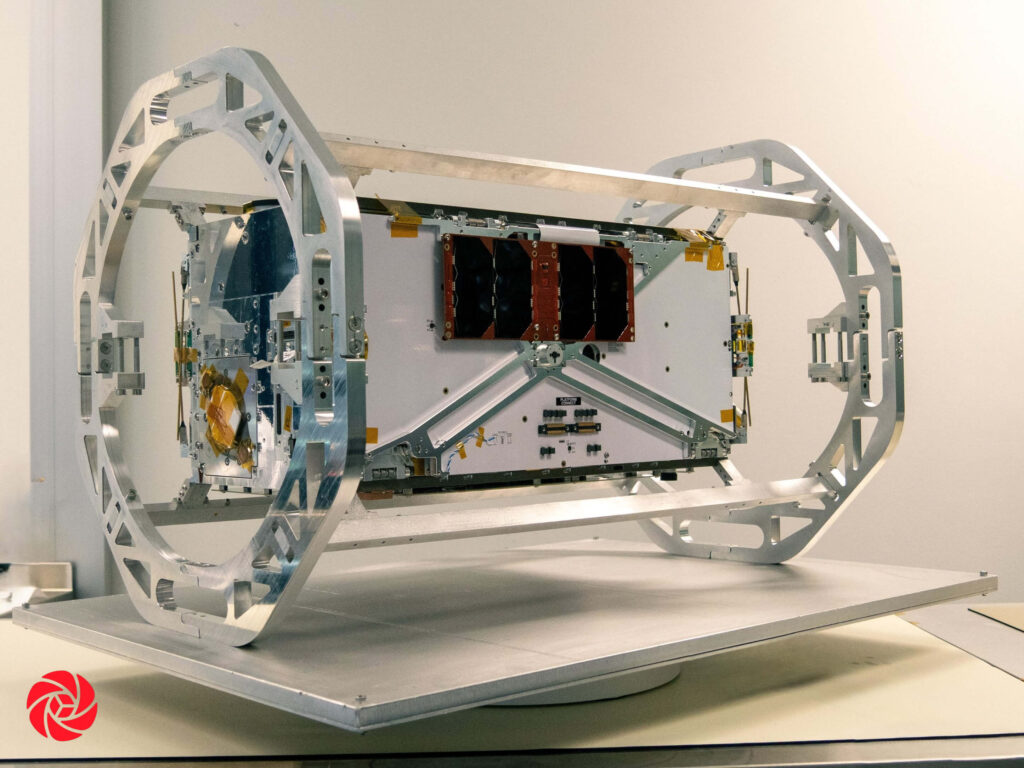
The image shows the GENA-OT satellite with its solar panels stowed away and the ICARUS antennas folded down on the side. – Ororatech GmbH
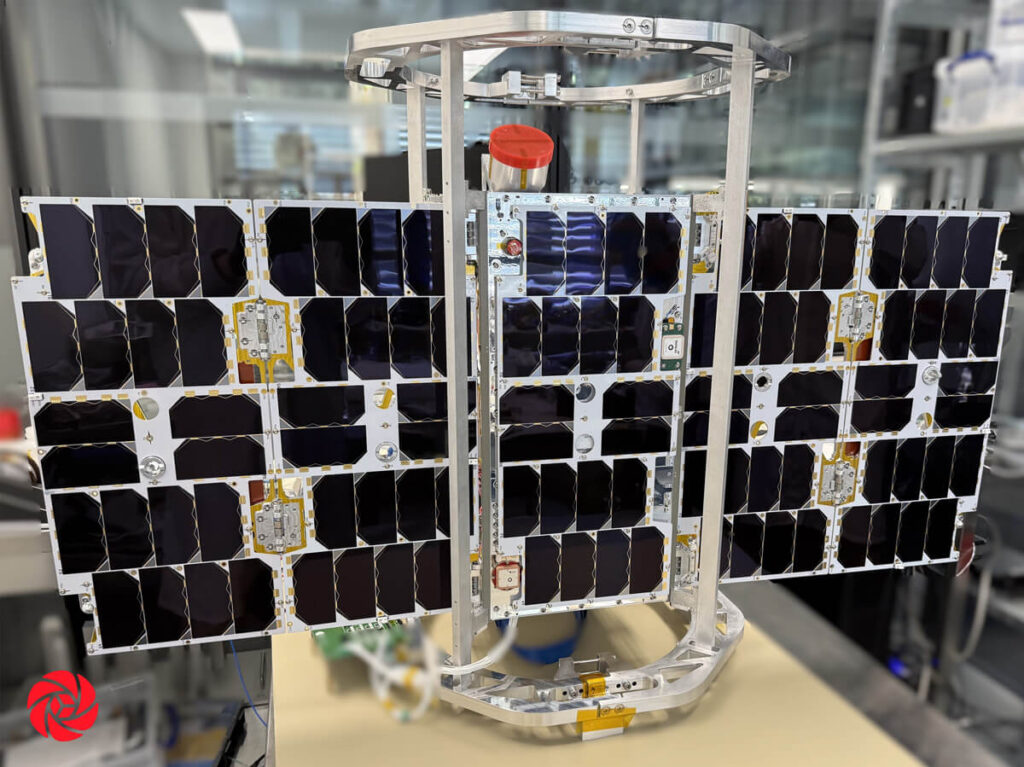
The image shows the zenith side of the GENA-OT satellite with all solar panels. – Ororatech GmbH
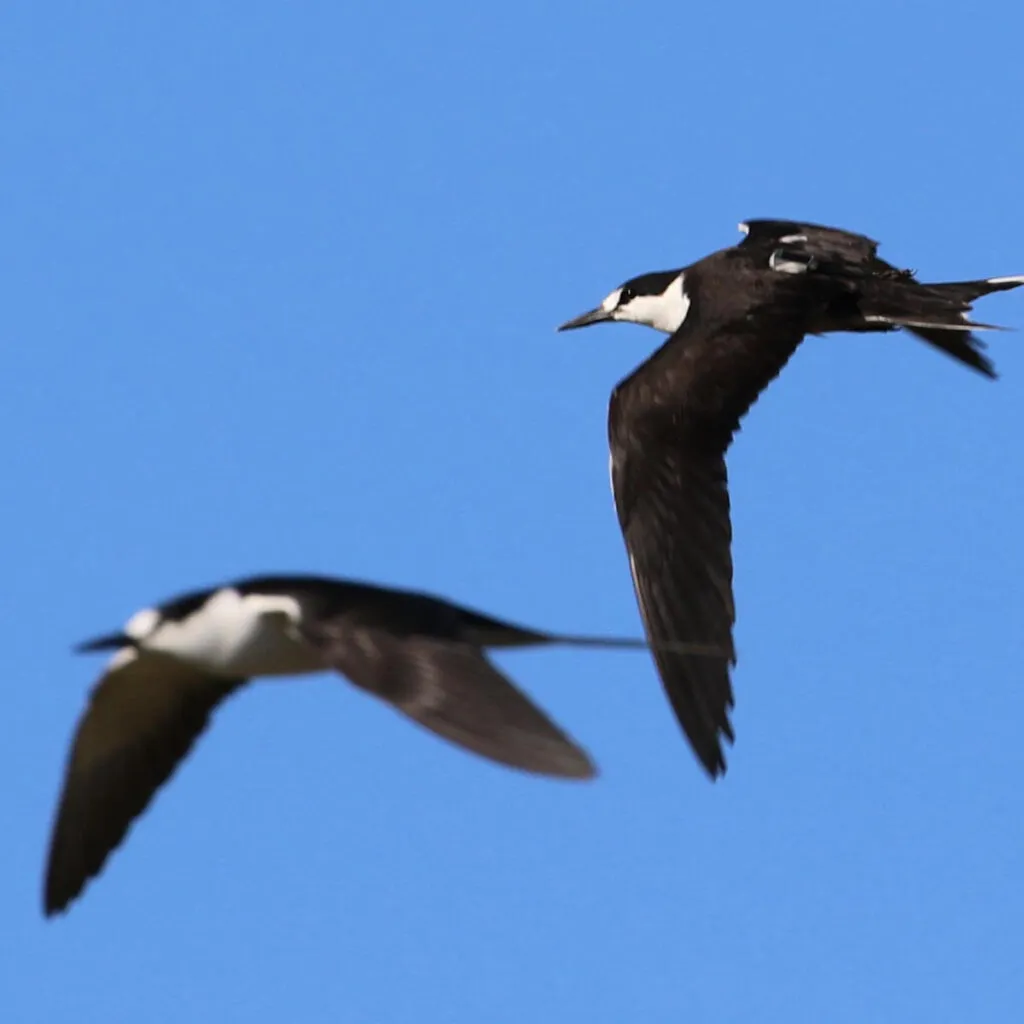
*Title image – Martin Wikelski / Max Planck Institute of Animal Behavior